
☀️ Happy Thursday! The Briefing is your guide to the world of news and information. Sign up here!
In today’s email:
- Featured story: FBI searches home of Washington Post journalist
- In other news: The role of legal observers, AI and false information in coverage of the ICE shooting in Minneapolis
- Looking ahead: Dan Bongino to return to podcasting after stint at FBI
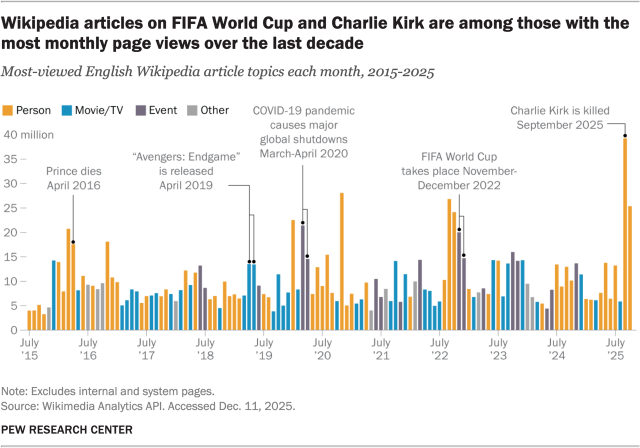
- Chart of the week: Over the last decade, Wikipedia articles on people and events in the news often had the most monthly views
🔥 Featured story
Yesterday, the FBI searched the home of Washington Post journalist Hannah Natanson as a part of an investigation into leaked government documents, raising concerns about press freedom and journalists’ security. Attorney General Pam Bondi said the Pentagon requested the search because Natanson “was obtaining and reporting classified and illegally leaked information from a Pentagon contractor.” Natanson has spent much of the past year reporting on the Trump administration’s efforts to reshape the federal government and has more recently worked on articles about U.S. actions in Venezuela.
About a month into President Donald Trump’s second term, a 2025 Pew Research Center survey found that Americans who had been closely following news about the Trump administration were much more likely than others to say they were extremely or very concerned about potential restrictions on press freedoms in the U.S. (49% vs. 29%).
Journalists’ concerns with government surveillance are not new. A 2014 Center survey of investigative journalists, conducted before Trump’s first term, found that nearly two-thirds (64%) believed that the U.S. government had probably collected data about their phone calls, emails or other online communications. And half said their employer was not doing enough to protect journalists and their sources from surveillance and hacking.
📌 In other news
- The role of legal observers in Minneapolis, as AI prompts confusion and false information about ICE shooting spreads; plus, how the role of video has changed between the George Floyd and Renee Good deaths
- BBC seeks to have Donald Trump’s defamation lawsuit dismissed
- Congress set to fund Voice of America despite Trump’s effort to shut it down
- How influencers are playing a new, often undisclosed, role in lobbying
- The Atlantic, Penske Media and Vox file antitrust suits against Google
- Some local TV stations are cutting ties with national news networks
- Journalists are often sent PR content from experts who don’t actually exist
- Job applicants for the U.S. military newspaper Stars and Stripes have been asked about support for Trump policies
📅 Looking ahead
Dan Bongino is returning to podcasting after recently stepping down from his position as deputy director of the FBI. During his time at the agency, Bongino sometimes refuted claims he had made on his popular show about topics including the Jan. 6, 2021, riot at the U.S. Capitol.
Bongino was among the most common answers in a 2024 survey when we asked Americans who regularly get news from news influencers on social media to name the first news influencer who comes to mind.
Around a third of U.S. adults (32%) say they get news from podcasts at least sometimes, with younger adults especially likely to do so, according to a 2025 Pew Research Center survey. Among Republicans, 31% of podcast news consumers say they trust the news they get from podcasts more than the news they get from other sources, compared with 18% who trust it less.
📊 Chart of the week
This week’s chart comes from a new Pew Research Center analysis of Wikipedia, which was launched 25 years ago today.
The most-viewed English Wikipedia articles each month from July 2015 to October 2025 range from the COVID-19 pandemic to recently deceased public figures to “Avengers: Endgame,” reflecting interests and news of the time. Since 2015, 46% of the most-viewed articles were about prominent individuals, 31% involved movies and TV shows, and 14% were about events.
👋 That’s all for this week.
The Briefing is compiled by Pew Research Center staff, including Naomi Forman-Katz, Joanne Haner, Sawyer Reed, Christopher St. Aubin, and Emily Tomasik. It is edited by Michael Lipka and copy edited by David Kent.
Do you like this newsletter? Email us at info@pewresearch.org or fill out this two-question survey to tell us what you think.
