Most Americans Now Say U.S. Foreign Policy Ignores the Interests of Other Countries
Partisans hold different views on whether the U.S. contributes to peace, considers other countries’ interests and garners respect around the world.
Numbers, Facts and Trends Shaping Your World
Read our research on:

All
Publications
Partisans hold different views on whether the U.S. contributes to peace, considers other countries’ interests and garners respect around the world.
Nearly six-in-ten U.S. adults are not confident that Trump can make good decisions about trade policy. Views of trade between the U.S. and China, Canada and Mexico have shifted since 2025.
Nearly three-quarters of German adults say relations with the United States are bad, while only 24% of U.S adults say the same of relations with Germany.
Economic optimism remains low in South Africa but is improving. Adults there increasingly see China favorably and value economic ties with China.
In nearly all the countries we surveyed, supporters of the governing party view their economy more positively than nonsupporters.
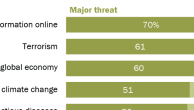
Adults across 25 countries see the spread of false information online, the condition of the global economy and terrorism as major threats today.
Seven-in-ten Americans view the spread of false information online as a major threat facing the nation in 2025.
People in many of 25 surveyed nations increasingly see China as the world’s top economic power.
People in 12 of 24 nations surveyed tend to say the U.S. is their top ally. But it’s also widely seen as a top threat, as are Russia and China.
Most Americans say the U.S. should give humanitarian aid to other countries, and majorities endorse aid supporting economic development and democracy.