
The Briefing
☀️ Happy Thursday! The Briefing is your guide to the world of news and information. Sign up here!
The Briefing will be on hiatus next week. Happy Thanksgiving! 🦃🌽
In today’s email:
- Featured story: McClatchy turns to AI after local newspaper layoffs
- New from Pew Research Center: How do the audiences of news sources differ based on how engaged they are in public life?
- In other news: Hundreds of thousands protest in Czechia over proposed public media funding change
- Looking ahead: Democrats’ relationship with new media ahead of the 2028 presidential election
- Chart of the week: The most engaged Americans are overrepresented in some news outlets’ audiences
🔥 Featured story
McClatchy is turning to artificial intelligence tools to bolster its newsrooms after cutting staff earlier this year. The parent company behind local newspapers including the Miami Herald and the Kansas City Star told employees this month that its business model was no longer sustainable, citing decreased website traffic and fewer paid subscribers. Instead, McClatchy will increasingly embrace an “AI-native operating model,” which has already led to disputes with reporters earlier this year.
In a Pew Research Center survey conducted in 2025, over half of Americans (56%) said finding out AI was used in a news article would make them feel less confident about what they learned, while only 7% said this would make them feel more confident.
And in a 2024 survey, Americans were five times more likely to predict that AI would have a negative impact than a positive impact on the news people get in the U.S. over the next 20 years. A majority (59%) expected that AI would lead to fewer journalism jobs in that time.
🚨 New from Pew Research Center
How Americans engage in public life varies based on where they get news. A new Pew Research Center analysis from the Pew-Knight Initiative matches responses from adults who took two surveys: one about which sources they get news from and another about how they engage in public life. This analysis shows how people in four different civic engagement groups are represented in the audiences of 30 national news sources, versus how they’re represented in the American public overall.
📌 In other news
- Hundreds of thousands protest in Czechia over proposed overhaul of public media funding
- Google removes over 19,000 pro-government YouTube channels in Indonesia as part of coordinated influence operations
- Chinese officials bar Bloomberg reporter from meetings with Russia and U.S. after she asked Trump about Jensen Huang
- A look at the foreign influencers Russia invited to make content in eastern Ukraine
- Unionized Reuters journalists vote to authorize strike
- Canada’s proposed budget would make funding for local news permanent
- Turkey continues media crackdown, raiding another TV station
- Switzerland prosecutes the first journalist under its banking secrecy law
- Newsmax sues to block Fox acquisition of Roku
- Court hears arguments on Pentagon media restrictions; new lawsuit filed over Defense Department’s alleged blacklisting of journalists
📅 Looking ahead
As the Democratic Party looks ahead to the 2028 presidential election, politicians and media figures are recognizing the role that new, independent media will play. An article from Semafor looks at new media outlets like Zeteo and More Perfect Union, as well as Twitch streamers like Hasan Piker, as increasingly powerful players in the left-leaning political world – so much so that Democratic hopefuls for the 2028 nomination are reaching out to some outlets for interviews.
Young Democrats may be especially reachable through independent media. A 2026 Pew Research Center survey found that younger Democrats are less likely than older Democrats to say they trust information from national news organizations and more likely than older Democrats to trust the news they get from social media. Younger Democrats are also more likely than their older counterparts to say they at least sometimes get news from podcasts – 36% of those ages 18 to 49 say this, compared with 25% of those ages 50 and older.
📊 Chart of the week
Americans who are most engaged in public life – who we call “Mobilizers” – make up a disproportionately large share of many news outlets’ audiences, according to the new analysis from the Pew-Knight Initiative. Just 9% of all U.S. adults are Mobilizers, compared with 19% of those who regularly get news from Axios and 18% of those who regularly get news from The Atlantic, among other examples.
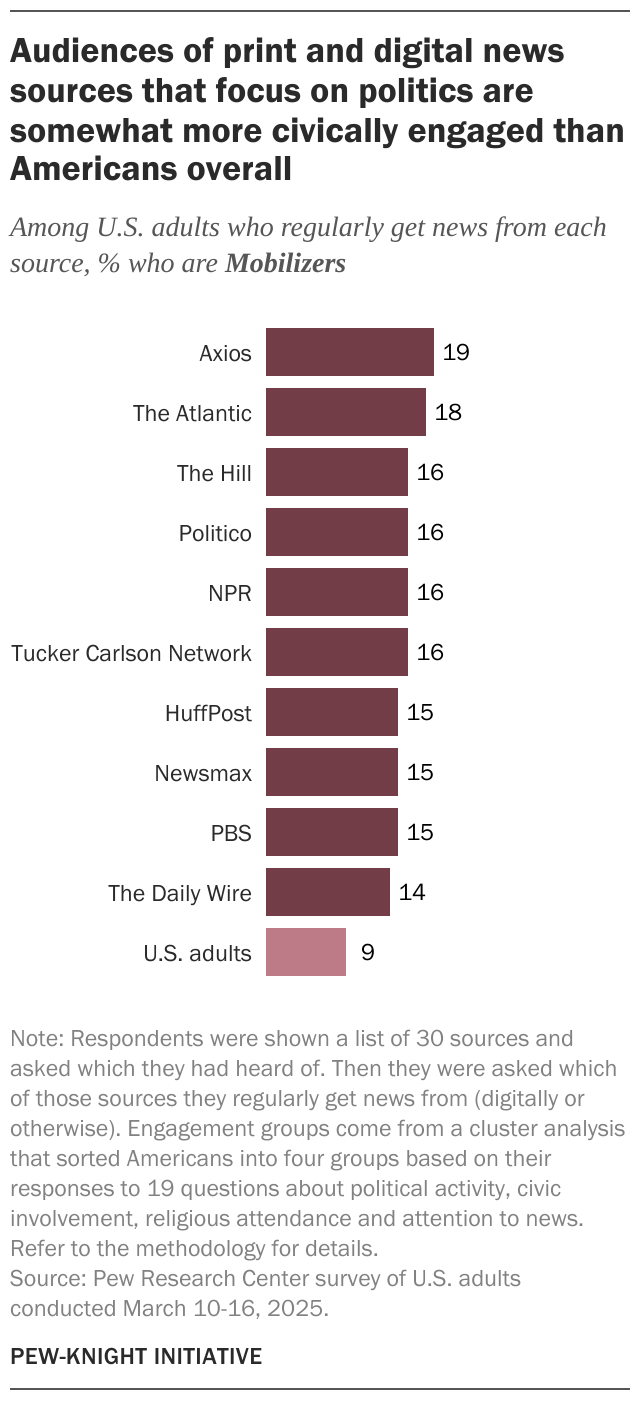
| Mobilizers | |
|---|---|
| Axios | 19 |
| The Atlantic | 18 |
| The Hill | 16 |
| Politico | 16 |
| NPR | 16 |
| Tucker Carlson Network | 16 |
| HuffPost | 15 |
| Newsmax | 15 |
| PBS | 15 |
| The Daily Wire | 14 |
| U.S. adults | 9 |
👋 That’s all for this week.
The Briefing is compiled by Pew Research Center staff, including Naomi Forman-Katz, Christopher St. Aubin, Emily Tomasik, Joanne Haner, and Sawyer Reed. It is edited by Michael Lipka and copy edited by Anna Jackson.
Do you like this newsletter? Email us at journalism@pewresearch.org or fill out this two-question survey to tell us what you think.
