
☀️ Happy Thursday! The Briefing is your guide to the world of news and information. Sign up here!
In today’s email:
- Featured story: California gubernatorial candidates partner with influencers to reach voters
- In other news: Trump admin proposes NDAs for all federal workers
- Looking ahead: Associated Press to share election data with OpenAI
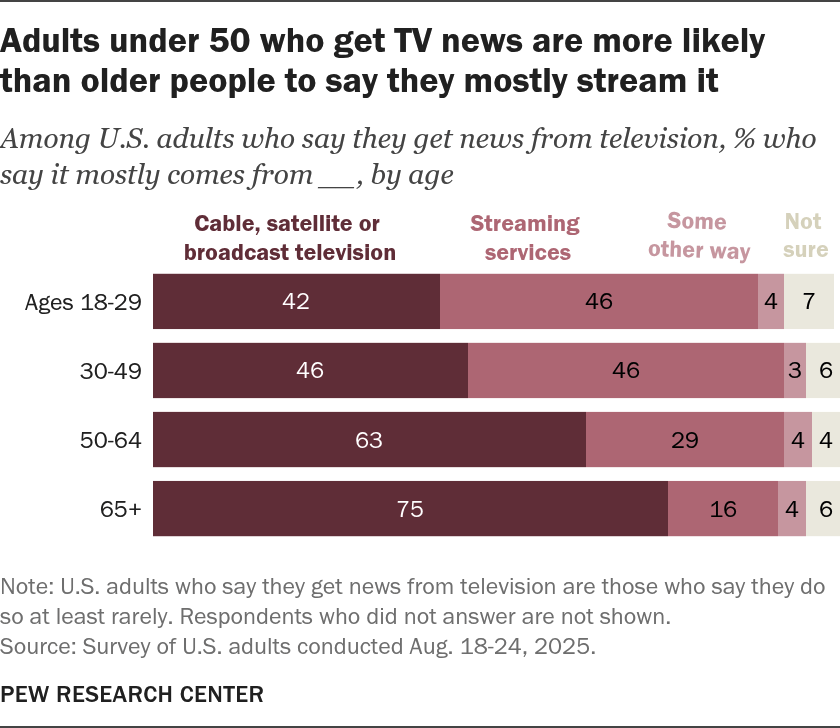
- Chart of the week: Younger adults who get TV news are more likely than older people to say they mostly stream it
🔥 Featured story
Political money is flowing to social media influencers, including in California’s gubernatorial race. Candidates like billionaire Tom Steyer are paying creators to promote their messages online, and recent campaign finance disclosures have revealed some payments to influencers reaching into the hundreds of thousands of dollars. But some observers have expressed concerns about the lack of transparency and the absence of legal requirements for influencers to disclose these payments – especially in contrast with the rules around political advertising in traditional media.
About one-in-five U.S. adults (21%) say they regularly get news from news influencers on social media, according to a 2025 Pew Research Center survey. Younger adults are especially likely to get news from news influencers, with 38% of those ages 18 to 29 saying they regularly do this.
When people who get news from news influencers on social media are asked why they do this, they cite a variety of factors as major reasons, including that influencers help them better understand current events and civic issues (54%), are quick in reporting on breaking news (54%), and are authentic (49%).
📌 In other news
- Trump administration proposes nondisclosure agreements for all federal government workers, citing concerns over media leaks
- CBS News names new executive producer for 60 Minutes, dismisses two correspondents
- Local newspaper unions accuse Hearst of anti-union tactics, and unionized employees say The New York Times is violating their contract by using AI to monitor employee performance
- CNN sues AI company Perplexity, alleging copyright violations
- The Economist launches its own ChatGPT app
- YouTube to more prominently label videos with significant use of generative AI
- American journalist charged with acting as an agent of the Chinese government
📅 Looking ahead
The Associated Press announced a deal to share its election data with OpenAI, allowing users to access vote counts from ChatGPT and other AI tools. While the AP has long been a leader in calling races on election night, the wire service sees this partnership as a way of shoring up the accuracy of election news and data people get from ChatGPT.
A 2020 Center survey found that many Americans followed results closely on Election Day that year, but there was not a wide understanding of how news organizations decide to announce who has won the presidential election in a state. Fewer than half of U.S. adults (44%) correctly answered that news outlets do this when they feel confident based on vote returns and other information, while 26% incorrectly said it is when state officials formally certify the results and 30% said they were not sure.
About one-in-ten Americans often or sometimes get news from AI chatbots like ChatGPT, according to a survey conducted last year. About a quarter of those who do get news from AI chatbots (24%) say it’s easy to determine what is true and what is not, while 33% say it’s difficult and 42% say they are not sure.
Read more about Americans’ views on artificial intelligence and chatbots.
📊 Chart of the week
This week’s chart comes from an August 2025 Pew Research Center survey on how Americans get news. While television remains among the most common news platforms for U.S. adults, people access TV news in different ways. Among those who get news from TV, most Americans ages 50 and older generally do so via cable, satellite or broadcast services, while nearly half of younger age groups get TV news through streaming services.
👋 That’s all for this week.
The Briefing is compiled by Pew Research Center staff, including Naomi Forman-Katz, Christopher St. Aubin, Emily Tomasik, Joanne Haner, and Sawyer Reed. It is edited by Michael Lipka and copy edited by David Kent.
Do you like this newsletter? Email us at info@pewresearch.org or fill out this two-question survey to tell us what you think.
