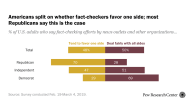
Republicans far more likely than Democrats to say fact-checkers tend to favor one side
Republicans largely say fact-checking by news outlets and other organizations favors one side. Democrats mostly think it is fair to all sides.
Numbers, Facts and Trends Shaping Your World
Read our research on:

All
Publications
Republicans largely say fact-checking by news outlets and other organizations favors one side. Democrats mostly think it is fair to all sides.
Many social media users in 11 emerging countries report being regularly exposed to misinformation when using the platforms.
What is the internet? Who is an internet user? Research suggests that some people who use the internet may not be aware that they’re doing so.
Most Americans anticipate widespread job automation in the future, and they generally foresee more negative than positive effects from these advances.
A majority of parents are concerned about the experiences their teen might encounter online. Parents take various actions to monitor and police their teen’s online behavior.
Access to mobile phones and social media is common across emerging economies. People around the world see certain benefits from these technologies, yet there are also concerns about their impact on children.
Access to mobile phones and social media is common across emerging economies. People around the world see certain benefits from these technologies, yet there are also concerns about their impact on children.
Pew Research Center released several reports in 2018 that explored the role and meaning of algorithms in people’s lives today.
About half of Facebook users say they are not comfortable when they see how the platform categorizes them, and 27% maintain the site’s classifications do not accurately represent them.


