
How Republicans and Democrats see their own ideology – and their party’s
In both coalitions, those who say they are more liberal or conservative than their party are also more critical of it.
Numbers, Facts and Trends Shaping Your World
Read our research on:

Research Associate
Gabriel Borelli is a research associate focusing on U.S. politics and policy at Pew Research Center.
In both coalitions, those who say they are more liberal or conservative than their party are also more critical of it.
Our typology sorts the public into nine groups based on their political and cultural values, not their party – painting a picture of American politics with far more than two colors.
Democrats and Democratic leaners are more likely than Republicans and GOP leaners to say they want more parties (46% vs. 29%).
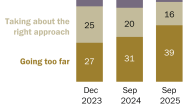
About six-in-ten now say they have an unfavorable view of the Israeli government, with a rising share saying Israel is “going too far.”
Six months into his term, far more say President Trump is making the way the federal government works worse than making it better.
Americans widely say that who the president is has a large impact on the country overall but a more limited impact on their own personal lives.
Republicans are less likely than in 2024 to say there is discrimination against Black, Hispanic, Asian and White people.
83% of Democrats say it’s extremely or very important that Democratic elected officials push hard against Trump’s policies when they disagree.
Overwhelming majorities expect transgender people (84%) and gay and lesbian people (76%) to lose influence under Trump.
Roughly two-thirds of U.S. adults (65%) say it would be “too risky” to give Trump more power to deal directly with many of the nation’s problems.
Notifications