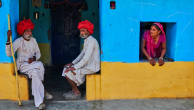
Key findings: How living arrangements vary by religious affiliation around the world
Globally, Muslims live in the biggest households, followed by Hindus, Christians, Buddhists, Jews and the religiously unaffiliated.
Globally, Muslims live in the biggest households, followed by Hindus, Christians, Buddhists, Jews and the religiously unaffiliated.
Household size and composition often vary by religious affiliation, data from 130 countries and territories reveals. Muslims and Hindus have larger households than Christians and religious “nones,” influenced in part by regional norms.
The global Muslim population is more concentrated in Islam’s main population centers than the global Christian population is for Christianity.
Almost 160 years after Charles Darwin publicized his groundbreaking theory on the development of life, Americans are still arguing about evolution. In spite of the fact that evolutionary theory is accepted by all but a small number of scientists, it continues to be rejected by many Americans.
Concentrated in Europe, Orthodox Christians have declined as share of the global Christian population, from 20% in 1910 to 12% today. But the Ethiopian community is highly observant and growing.
African immigrants make up a small share of the U.S. immigrant population, but their numbers are growing – roughly doubling every decade since 1970.
There are important differences in educational attainment among religious groups living in the same region — or even the same country.
One-quarter of all U.S. Latinos self-identify as Afro-Latino, Afro-Caribbean or of African descent with roots in Latin America.
Depending on the topic, urban residents are more likely to use mobile and online sources; suburbanites are most heavily into social media; and rural residents are more inclined to word of mouth sources
The 5-4 decision by the U.S. Supreme Court in June to strike down school desegregation plans in Seattle and Louisville has focused public attention on the degree of racial and ethnic integration in the nation’s 93,845 public schools.