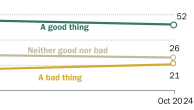
Views of DEI have become slightly more negative among U.S. workers
About half of workers (52%) now say focusing on increasing DEI at work is mainly a good thing, down from 56% in February 2023.
About half of workers (52%) now say focusing on increasing DEI at work is mainly a good thing, down from 56% in February 2023.
Democrats and those who lean to the Democratic Party are more likely than Republicans and Republican leaners to say they will get an updated COVID-19 vaccine.
Today, 47% of U.S. women ages 25 to 34 have a bachelor’s degree, compared with 37% of men.
This study explores the makeup of the social media news influencer universe, including who they are, what content they create and who their audiences are.
Among U.S. adults, those who live in the Northeast (17%) are more likely than those in the South (10%), West (8%) and Midwest (7%) to be nondrivers.
Americans’ trust in scientists is slightly higher than it was last year, but remains lower than before the COVID-19 pandemic.
The economy was the most important issue for Trump voters this year; 93% of his supporters said it was very important to their vote.
Most Americans see cellphone distraction behind the wheel as a major problem in their local community, and about a quarter report witnessing road rage often.
While 84% of Americans and 74% of Germans perceived U.S.-German relations as good, their views differed on some international issues.
In 2022, single women without children had a median wealth of $87,200, while the typical single man had $82,100.