
The Briefing
☀️ Happy Thursday! The Briefing is your guide to the world of news and information. Sign up here!
In today’s email:
- Featured story: NPR retracts Alito retirement story
- New from Pew Research Center: Which Americans are most likely to have spoken with a local journalist?
- In other news: The Onion relaunches InfoWars website
- Looking ahead: C-SPAN program will help cover local midterm elections
- Chart of the week: Where do Americans get local political news?
🔥 Featured story
NPR on Tuesday posted and retracted a story that incorrectly reported Supreme Court Justice Samuel Alito was retiring. Veteran journalist Nina Totenberg, who wrote the article, said she mistakenly believed a court announcement about upcoming retirements referred to Alito. The story was published for only a few minutes before being removed, and NPR issued a correction. Totenberg took responsibility for the error and personally apologized to Alito, saying she had “assumed something no reporter should ever do.”
Most Americans say they value transparency from journalists in how they handle mistakes. In a 2025 Center survey, about two-thirds of U.S. adults (66%) said it is extremely or very important for journalists to share with their audiences how they handle mistakes in their work.
🚨 New from Pew Research Center
About a quarter of Americans (23%) say they have ever spoken with or been interviewed by a local journalist or reporter, according to a new Pew Research Center analysis from the Pew-Knight Initiative. Some groups are more likely than others to say this, including adults with more formal education and higher family incomes.
📌 In other news
- The Onion relaunches InfoWars website
- Supreme Court denies Alan Dershowitz appeal in defamation case against CNN
- U.K. government may challenge Paramount-Warner Bros. merger
- New York Times’ Wirecutter podcast coming to public radio
- Committee to Protect Journalists will review its database of journalists killed in war zones after previous errors
- Axel Springer completes takeover of The Telegraph
- Fact-checkers worldwide face AI threats and shrinking budgets
📅 Looking ahead
C-SPAN has announced a new initiative that will send journalists to film candidate town halls, forums and campaign events in at least 10 states during the 2026 midterm elections, then share the footage with nonprofit and independent local newsrooms for free. The program is intended to address what C-SPAN describes as a growing shortage of local political journalism, particularly video coverage of congressional campaigns.
Americans do not widely see it as easy to find the news and information they need to take part in the local political process, according to a 2024 Center survey. A much higher share of Americans say they are at least somewhat interested in news about local elections (70%) than say it is very or somewhat easy to find the information they need to make voting decisions (45%).
There is virtually no difference between the shares of Democrats and Republicans (including independents who lean toward each party) who say it is easy to find the information they need to vote in local elections. But younger adults are less likely than those ages 50 and older to say it is easy to find this information.
📊 Chart of the week
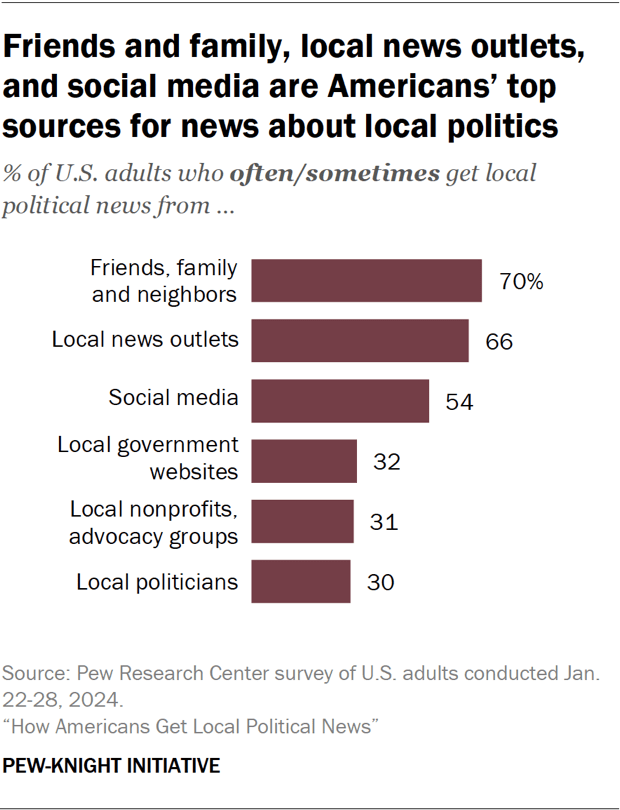
This week’s chart comes from a 2024 Center survey that asked U.S. adults how they get news about local government and politics. Americans get this news from a variety of sources: the most common are friends, family and neighbors (70%) and local news outlets (66%). Just over half (54%) say they often or sometimes get local political news from social media.
👋 That’s all for this week.
The Briefing is compiled by Pew Research Center staff, including Naomi Forman-Katz, Christopher St. Aubin, Emily Tomasik, Joanne Haner, and Sawyer Reed. It is edited by Kirsten Eddy and copy edited by Anna Jackson.
Do you like this newsletter? Email us at journalism@pewresearch.org or fill out this two-question survey to tell us what you think.
