
This newsletter was delayed due to a Microsoft service outage – thanks for your patience.
☀️ Happy Friday! The Briefing is your guide to the world of news and information. Sign up here!
In today’s email:
- Featured story: BBC announces content deal with YouTube
- In other news: TikTok finalizes deal to create U.S. entity
- Looking ahead: California budget proposal includes no funding for local news
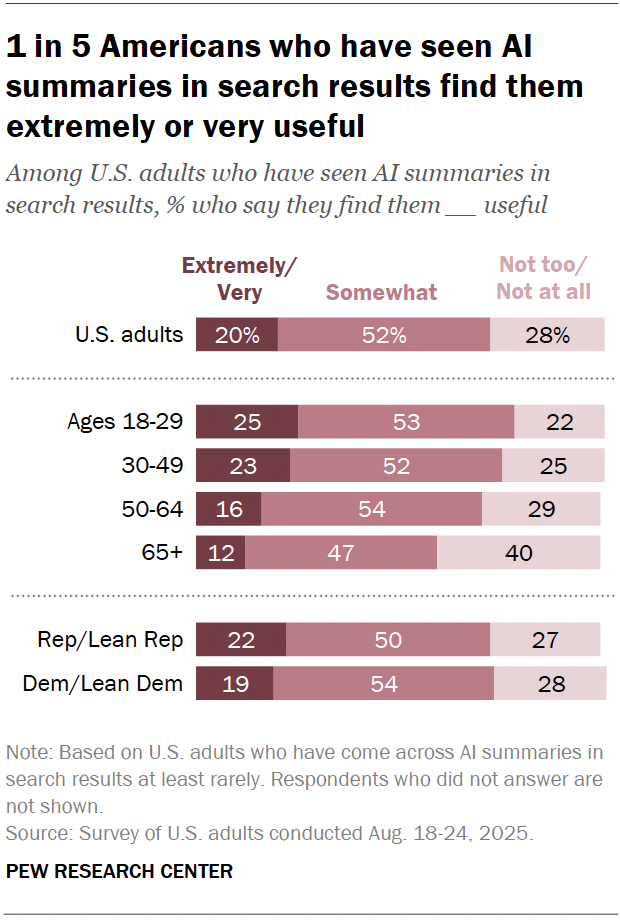
- Chart of the week: 1 in 5 Americans who have seen AI summaries in search results find them extremely or very useful
🔥 Featured story
The BBC announced a deal with YouTube this week to make original content for the video-based platform, including news, sports and entertainment. This content will be freely available in the United Kingdom and will include ads if viewed elsewhere around the world.
In the United States, YouTube is an increasingly common destination for news, according to a recent Pew Research Center survey. The share of Americans who say they regularly get news on YouTube has grown from 23% in 2020 to 35% in 2025.
According to a separate Center survey conducted in March 2025, 21% of Americans regularly get news from BBC News, and about a third (35%) say they trust it as a source of news (compared with 13% who distrust it).
📌 In other news
- TikTok strikes deal to keep operating in the U.S.; Canadian court rules TikTok can continue to operate in the country
- Minnesota judge declines to approve criminal complaint against former CNN anchor Don Lemon
- Judge says prosecutors cannot yet review materials seized from Washington Post reporter’s home
- ChatGPT to begin rolling out ads for logged-in U.S. users
- FCC releases new guidance focused on political equal time rules
- New media newsletter from Mediaite launches to summarize other media newsletters
- Why the Pentagon is taking control of military newspaper Stars and Stripes
- A look at the increasing presence of prediction markets in U.S. media
- Republican lawmakers begin enforcing recording rules in Wisconsin state capitol after network that broadcasted them goes under
- How a FiveThirtyEight chart fueled theories of election fraud in 2020
📅 Looking ahead
California Gov. Gavin Newsom’s budget proposal for the 2026-27 fiscal year contains no additional money for a local news fund. This comes after an August 2024 agreement between California and Google to spend $175 million over five years to fund local journalism – replacing legislation that would have forced Google to pay news organizations for using their content. Newsom cited budgetary constraints in cutting the state’s commitment to the California Civic Media Fund from $30 million to $10 million for fiscal year 2025-26. Google later said it was matching the state’s $10 million.
In a 2024 Pew Research Center survey, 15% of Americans said they paid for local news in the last year – whether through subscribing, donating or becoming a member – while 85% said they had not. Among those who hadn’t paid for local news in the last year, roughly half (49%) said the main reason was that they can find plenty of free local news.
In that same survey, we found that a majority of U.S. adults (63%) said they think their local news outlets are doing at least somewhat well financially, down from 71% in 2018.
📊 Chart of the week
This week’s chart comes from an August 2025 Pew Research Center survey. Among U.S. adults who have seen artificial intelligence (AI) summaries in search engines like Google or Bing, 20% find them extremely or very useful. About half (52%) find them somewhat useful, while 28% say they are not too or not at all useful.
Younger age groups are somewhat more likely than older adults to find AI summaries in search results helpful.
👋 That’s all for this week.
The Briefing is compiled by Pew Research Center staff, including Naomi Forman-Katz, Joanne Haner, Sawyer Reed, Christopher St. Aubin and Emily Tomasik. It is edited by Michael Lipka and Kirsten Eddy and copy edited by Mia Hennen.
Do you like this newsletter? Email us at journalism@pewresearch.org or fill out this two-question survey to tell us what you think.
