
☀️ Happy Thursday! The Briefing is your guide to the world of news and information. Sign up here!
The Briefing will be on hiatus until Thursday, Jan. 8.
Happy holidays! ❄️
In today’s email:
- Featured story: Netflix strikes video podcast deals with iHeartMedia and Barstool Sports
- In other news: Trump files $10 billion lawsuit against BBC over editing of documentary
- Looking ahead: Wall Street Journal launches newsletter-focused opinion brand
- Chart of the week: Party differences in trust and distrust of news sources
- Director’s note: Navigating the news in the age of AI and influencers
🔥 Featured story
This week, Netflix announced deals with iHeartMedia and Barstool Sports to publish video podcast episodes from select shows exclusively on Netflix beginning in early 2026, furthering the streaming platform’s push into podcasting.
Just over half of U.S. adults (54%) say they’ve listened to a podcast in the past 12 months, according to a Pew Research Center survey from August. And 72% of Americans say they ever watch programming on Netflix, making it one of the most widely used streaming platforms, according to an April survey.
Videos are also common in podcasting: A 2023 analysis found that about half of top podcasts (51%) produce a video to accompany most episodes.
📌 In other news
- President Donald Trump files $10 billion lawsuit against BBC over editing of documentary
- FCC updates website wording after Brendan Carr states agency isn’t independent in Senate committee hearing
- Arkansas will be the first state to end its PBS affiliation
- Spanish-language community radio stations adapt in response to immigration crackdowns
- CBS News to host a series of primetime town halls and debates
- U.S. broadcaster E.W. Scripps board rejects Sinclair’s acquisition proposal
- A look at a Bay Area radio station’s troubles with the Trump administration
- Warner Bros. Discovery board recommends shareholders reject Paramount deal in favor of Netflix proposal
📅 Looking ahead
This week, the Wall Street Journal launched “Free Expression,” a newsletter-focused opinion brand expanding its opinion coverage beyond its current business and financial focus. “Free Expression” will exist as a section of the paper’s website, and readers can also access the new opinion content on Substack.
In a 2025 Center analysis asking what “news” is to Americans today, we find people make clear distinctions between “news” and opinion or commentary, emphasizing the idea of news as “just the facts.” At the same time, views of news as not being “biased” or “opinionated” can conflict with people’s actual preferences. For instance, 55% of Americans say it’s at least somewhat important that their news sources share their political views.
📊 Chart of the week
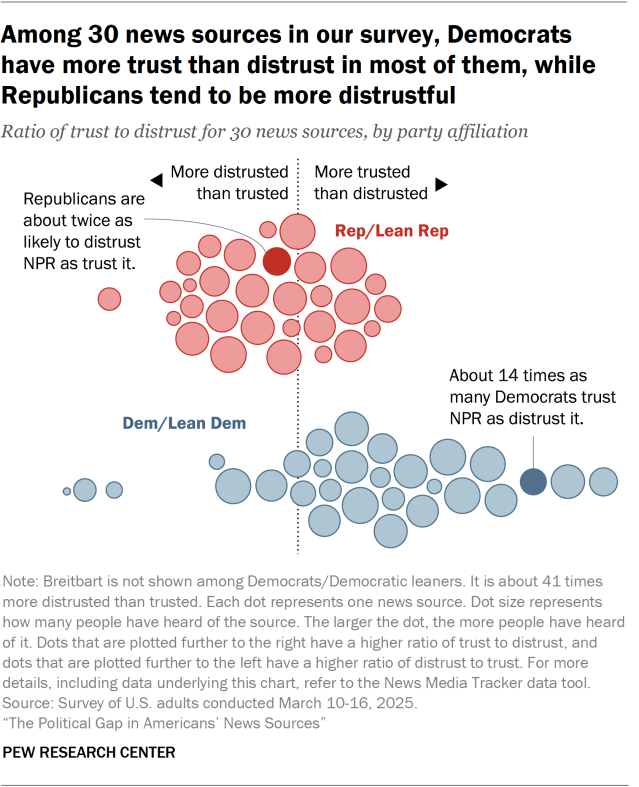
This week’s chart – one of the Center’s favorite data visualizations of 2025 – comes from our study on Americans’ use of and trust in 30 major news sources.
Each dot in this graphic represents a news source, while its size shows how many people have heard of the news source. The dots are placed along a trust/distrust axis, where dots that are plotted farther to the right have a higher ratio of trust to distrust – and vice versa. Responses are also grouped by party affiliation, showing that Republicans and GOP leaners distrust more than trust most of the outlets in this study, while the opposite is true of Democrats and Democratic leaners.
💡 Director’s note
Insights from Katerina Eva Matsa, director of news and information research:
In 2026, the challenge isn’t finding news – it’s knowing what to trust. Artificial intelligence, influencers and polarization are rewriting the rules.
As we look ahead, one question looms large: What does trust in news look like in 2026? At Pew Research Center, we’ve found that Americans increasingly struggle to separate fact from fiction online. Three forces are reshaping this challenge:
- Generative AI is emerging as a new gateway to news, promising convenience but raising concerns about transparency and accuracy.
- Influencers are becoming news anchors for younger audiences, signaling a shift from institutional credibility to personality-driven trust.
- Polarization continues to fracture shared reality, making verification not just a technical hurdle but a civic one.
The future of journalism may hinge on whether trust migrates from institutions to individuals – or to algorithms. The coming year won’t just test the resilience of traditional journalism; it will test whether society can maintain a shared sense of reality in an information ecosystem optimized for speed, personalization and engagement.
👋 That’s all for this week.
The Briefing is compiled by Pew Research Center staff, including Naomi Forman-Katz, Jacob Liedke, Christopher St. Aubin, Luxuan Wang, Emily Tomasik, Joanne Haner, Sawyer Reed and Katerina Eva Matsa. It is edited by Kirsten Eddy and copy edited by Mia Hennen.
Do you like this newsletter? Email us at journalism@pewresearch.org or fill out this two-question survey to tell us what you think.
