
☀️ Happy Thursday! The Briefing is your guide to the world of news and information. Sign up here!
In today’s email:
- Featured story: BBC apologizes to Trump over editing of Jan. 6 documentary
- In other news: Kansas officials pay damages, apologize for 2023 raid on local newspaper
- Looking ahead: Expanding use of AI in newsrooms
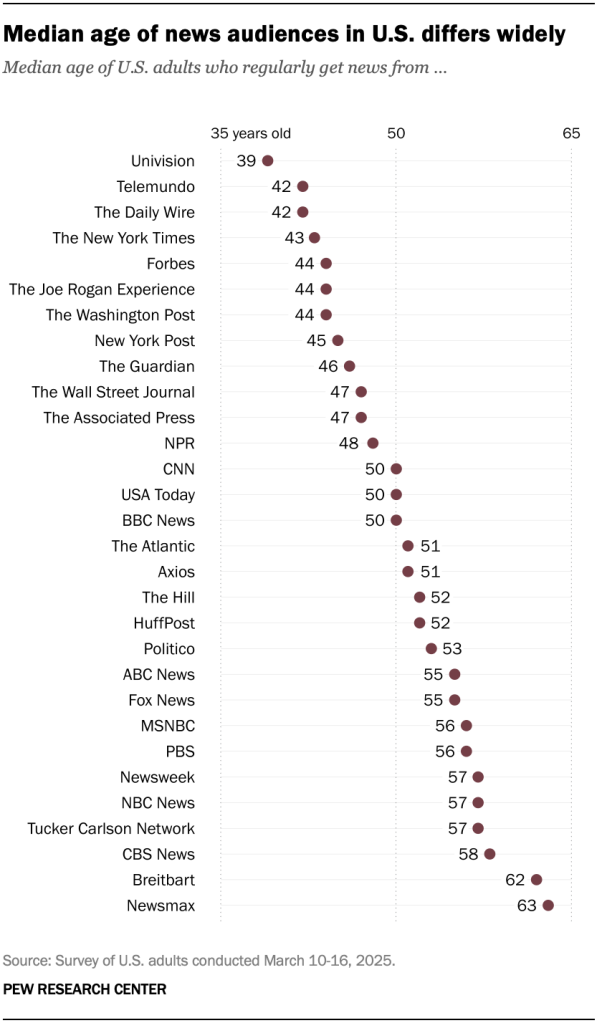
- Chart of the week: Median ages of U.S. news audiences
🔥 Featured story
The BBC apologized to President Donald Trump on Thursday for the way a 2024 documentary edited a speech he gave before the U.S. Capitol riot on Jan. 6, 2021. Two top BBC executives had already resigned last weekend amid the backlash, and Trump’s legal team threatened a $1 billion lawsuit against the BBC.
In the U.S., 21% of Americans regularly get news from BBC News, according to a 2025 Pew Research Center survey. Democrats are about twice as likely as Republicans to say they regularly get news from the outlet (30% vs. 13%). A similar pattern emerges when it comes to who trusts BBC News as a source: 52% of Democrats and 20% of Republicans say they do.
📌 In other news
- Kansas officials agree to pay damages, apologize for 2023 raid on local newspaper
- Former FCC commissioners urge agency to eliminate “news distortion” policy
- YouTube TV dispute with Disney drags on
- New content strategies for online news sites emerge in the age of AI
- How Fox News covered protests in Portland
- Boston student journalism program brings local reporting to New England newsrooms
- The New York Times announces new investigative reporting partnership in the South
- Meta’s Threads launches new features for podcast creators
📅 Looking ahead
Newsrooms are increasingly using artificial intelligence in their reporting, as The New York Times explored in a recent article. Bloomberg, Axios, Fortune and The Associated Press are among the outlets publicly incorporating AI into their newsroom processes to help with tasks like analyzing meeting transcripts and large datasets or even drafting entire articles.
In an August 2024 Pew Research Center survey, Americans were more likely to say that AI would be worse than human professionals when writing news stories than to say it would be better (41% vs. 19%). Another 20% said AI would do about the same as humans, and 20% said they weren’t sure. In the same survey, 59% of respondents predicted that AI would lead to fewer journalism jobs in the next 20 years.
📊 Chart of the week
This week’s chart comes from a Center analysis of 30 major news sources published earlier this year. When looking at the median age of their U.S. audiences, some interesting differences arise.
The median age of American adults who regularly get news from Univision is 39 – the youngest of any source we studied. By comparison, the median ages of adults who regularly get news from Newsmax and Breitbart are 63 and 62, respectively – the oldest in the survey.
👋 That’s all for this week.
The Briefing is compiled by Pew Research Center staff, including Naomi Forman-Katz, Jacob Liedke, Christopher St. Aubin, Emily Tomasik, Joanne Haner and Sawyer Reed. It is edited by Michael Lipka and copy edited by Anna Jackson.
Do you like this newsletter? Email us at journalism@pewresearch.org or fill out this two-question survey to tell us what you think.
