Young Adults and the Future of News
Illustrations by Christa Jarrold
The ways Americans get news and information have transformed dramatically in the 21st century. The news habits of the youngest adults reflect this shift – and may offer some insight into what the future holds.

% of U.S. adults who say they follow the news all or most of the time, by age
Notes
Source: Survey of U.S. adults conducted Aug. 18-24, 2025. Refer to our detailed tables for the underlying data and dates of other surveys.
PEW-KNIGHT INITIATIVE
Young adults follow the news less closely than any other age group. Overall attention to news has declined since 2016, and the youngest age group has remained consistently at the bottom.

% of U.S. adults who say they get news from social media at least sometimes, by age
Notes
Note: Respondents who do not use the internet were not asked this question.
Source: Survey of U.S. adults conducted Aug. 18-24, 2025. Refer to our detailed tables for the underlying data and dates of other surveys.
PEW-KNIGHT INITIATIVE
At the same time, there is one place where young adults are more likely to get news than any other age group: social media.

% of U.S. adults who say they have a lot of/some trust in the information that comes from social media sites, by age
Notes
Note: Data from 2016 based on only internet-using U.S. adults. Question wording has changed over time. For more detail, refer to the topline.
Source: Survey of U.S. adults conducted Sept. 8-14, 2025. Refer to our detailed tables for the underlying data and dates of other surveys.
PEW-KNIGHT INITIATIVE
Adults under 30 also are more likely than any other age group to trust the news they see on social media sites. In fact, young adults trust information from social media as much as they trust information from national news organizations.

The Pew-Knight Initiative supports new research on how Americans absorb civic information, form beliefs and identities, and engage in their communities.
Pew Research Center is a nonpartisan, nonadvocacy fact tank that informs the public about the issues, attitudes and trends shaping the world. Knight Foundation is a social investor committed to supporting informed and engaged communities. Learn more >
To better understand the U.S. media landscape, Pew Research Center has surveyed Americans over time about their news habits and attitudes. Time and time again, the youngest adults stand out from the crowd in their unique ways of consuming news and their views of the news media.
This essay examines how the youngest group of adults – those ages 18 to 29 – consume news, interact with it and perceive its role in their daily lives. In doing so, it paints a picture of a generation of Americans that is both shaping and being shaped by the evolving news environment. As we look toward the future, understanding young adults’ news habits may be key to anticipating the coming shifts in the media landscape.
Throughout this essay, we include quotes from young Americans gathered from several past Center studies to illustrate their experiences.
This is a Pew Research Center analysis from the Pew-Knight Initiative, a research program funded jointly by The Pew Charitable Trusts and the John S. and James L. Knight Foundation.
Young adults are less likely to follow the news
Attention to news in the U.S. – measured by the share of adults who say they follow news all or most of the time – has declined across all age groups since 2016. Young adults (ages 18 to 29) have consistently had the lowest levels.
| Type of news | Ages 18-29 | 30-49 | 50-64 | 65+ |
|---|---|---|---|---|
| National news | 54 | 61 | 77 | 85 |
| Local news | 48 | 55 | 71 | 78 |
As of 2025, 15% of young adults say they follow the news all or most of the time. Comparatively, 62% of the oldest Americans say they do this – about four times as many. This holds true for different types of news. Young adults are less likely than all older age groups to say they closely follow national and local news.
Younger adults also differ in the news topics they follow. They tend to be less likely than older adults to say they often or extremely often get news about government and politics, science and technology, and business and finance. They are only slightly less likely to often get sports news – and more likely to get entertainment news. About a third (32%) of adults under 30 say they get entertainment news extremely often or often, compared with 13% of the oldest adults (those 65 and older).
| Age group | Percentage |
|---|---|
| Ages 18-29 | 22 |
| 30-49 | 36 |
| 50-64 | 53 |
| 65+ | 66 |
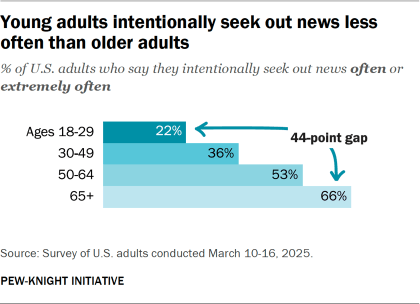
Even though young adults are less likely to report following the news, news may still be finding them in other ways.
When asked how often they seek out the news, about one-in-five young adults (22%) say they do so often or extremely often. Older adults are much more likely to intentionally seek out news.
| Age group | Because they are looking for it | Because they happen to come across it |
|---|---|---|
| Ages 18-29 | 30 | 70 |
| 30-49 | 39 | 60 |
| 50-64 | 50 | 49 |
| 65+ | 61 | 38 |
But while young adults’ intentional news consumption is much lower, they are more likely to get news incidentally – that is, without looking for it. When it comes to political news, 70% of young adults say they get it because they happen to come across it, compared with 30% who seek it out. The oldest adults show the reverse pattern, with those 65 and older more likely to get news because they’re looking for it.
Social media is a common place for incidental news exposure – users often encounter news while using these platforms for other reasons.
Why do younger adults follow the news less closely? One possibility is that young adults are much less likely to feel attached to their community than their elders – which may help explain, or result from, their lower news consumption.
Another is the way the news makes them feel. Young people are more likely to say the news they get makes them feel scared or confused, with 33% saying it makes them feel each of these emotions often or extremely often.
“I try to avoid it for my sanity,” a 24-year-old woman said. “If I watch too much of the negativity in the news, it affects my mood.”
Meanwhile, older adults are more likely than their younger counterparts to say they often feel informed when they get news (refer to the appendix for details).
Where young adults get news
% of U.S. adults who say they often or sometimes get news from …
Note: Refer to our detailed tables for the underlying data.
Source: Survey of U.S. adults conducted Aug. 18-24, 2025.
PEW-KNIGHT INITIATIVE
Young adults stand out from older Americans in where they get their news. They are generally less likely than older Americans to get their news from traditional platforms, like television and radio. Instead, 93% say they at least sometimes get news from digital devices.
As one 25-year-old woman shared, “When I first started to get into news and what was going on around me to stay informed I typically would rely more on cable television. However, now since technology has advanced in the past 10 years, I rely more on online platforms that give me breaking news wherever I’m at.”
Young adults also stand out in where they get news on digital devices: Adults under 30 are much more likely to get news on social media than older adults. There is a 48 percentage point gap between the shares of Americans ages 18 to 29 and those 65 and older who get news on social media at least sometimes (76% vs. 28%).
Compared with older adults, young adults are especially likely to get news from Instagram and TikTok. The difference is stark even between those ages 18 to 29 and the next oldest age group, ages 30 to 49.
| Social media site | Ages 18-29 | 30-49 | 50-64 | 65+ |
|---|---|---|---|---|
| 41 | 45 | 36 | 27 | |
| YouTube | 41 | 37 | 35 | 25 |
| 40 | 26 | 11 | 5 | |
| TikTok | 43 | 25 | 10 | 3 |
Young adults are also more likely to say they prefer social media for getting the most up-to-date information about breaking news. As one 22-year-old woman shared about a breaking news event, “I first saw on TikTok … then I saw an article the next day on Fox News and other different news sites.”
Perhaps one of the clearest differences in online news habits between young adults and their elders is young adults’ tendency to get news from news influencers – individuals with a large social media following who often post about news, politics or social issues. Among adults under 30, about four-in-ten (38%) say they regularly get news from news influencers. Comparatively, 23% of adults 30 to 49 years old say the same, a share that continues to decrease with age.
A 21-year-old man explained why he turns to news influencers for news: “If I agree with that person already, if I already have background with that person, then I’ll probably trust him more than some news site.”
Even though many use video-based social media sites, young adults are less likely than older Americans to say they prefer watching the news. This may be due in part to older Americans’ preference for getting news on TV. Young adults, by contrast, are more likely than Americans 50 and older to prefer reading or listening to the news.
Outside of social media, there is no other digital platform for news consumption where adults under 30 are as consistently different from all older age groups.
For example, about three-in-ten young adults at least sometimes get news from email newsletters – similar to other age groups. And while adults under 50 are more likely than those 50 and older to get news from podcasts, there is no difference between people in the 18 to 29 category and those in their 30s and 40s (39% each). Young adults, meanwhile, are less inclined than those ages 30 to 64 to get news from news websites or apps.
About seven-in-ten adults under 30 (69%) say they at least sometimes get news from Google or other search engines, similar to those ages 30 to 64. The oldest Americans, those 65 and older, are less likely to do this: Only half often or sometimes get news from search engines.
Young adults are slightly more likely than the two oldest age groups to say they get news from AI chatbots (13%), but the share who get news this way is still relatively small compared with other digital platforms.
Trust in news sources
Young Americans are also more likely than older ones to trust information from social media. Half of the youngest adults say they have a lot of or some trust in the information that they get from social media sites – higher than any other age group.
| News platform | Ages 18-29 | 30-49 | 50-64 | 65+ |
|---|---|---|---|---|
| National news organizations | 51 | 52 | 58 | 62 |
| Local news organizations | 65 | 67 | 72 | 76 |
| Social media sites | 50 | 41 | 33 | 24 |
“I would say I trust Twitter or X the most, because pretty much anyone can post on it,” shared a 28-year-old man. “So, I know that could mean there’s some weird information, but if everyone can post on it, it’s not biased to me, per se.”
In contrast, young adults are less likely than most other age groups to trust the information they get from local and national news organizations. As a 25-year-old woman shared, “Often times I find myself having to seek alternative news outlets or articles to get the full story of what really is happening or to fill in the gaps of missing details.”
In a survey about trust in 30 major news sources, there were virtually none that young adults were more likely than older adults to trust. Older adults were more likely to trust most sources, while a handful were about equally trusted by all age groups.
How young adults think about journalists
Young adults define what a “journalist” is more broadly than older Americans – with many saying it can include podcast hosts, newsletter writers and social media content creators. Adults under 30 are more likely than older adults to consider someone a journalist if they write their own newsletter about news or make their own news-related videos or posts on social media.
| Work | Ages 18-29 | 30-49 | 50-64 | 65+ |
|---|---|---|---|---|
| Writes for a newspaper or news website | 80 | 81 | 79 | 73 |
| Reports on or hosts a TV news show | 68 | 68 | 63 | 58 |
| Reports on or hosts a radio news show | 60 | 65 | 57 | 50 |
| Reports on or hosts a news podcast | 55 | 53 | 40 | 33 |
| Writes their own newsletter about news | 56 | 44 | 33 | 29 |
| Makes their own videos or posts about news on social media | 41 | 31 | 20 | 14 |
Young adults are also less concerned than their elders about whether the news they get comes from journalists. About half of those under 30 (51%) say they prefer to get news from people they think of as journalists, compared with 69% of the oldest adults.
As the field of journalism is changing, so too are attitudes toward traditional journalistic norms.
Younger adults tend to be more likely than older ones to say it is acceptable for journalists to advocate for the communities they cover and to express their political and religious views – both in their reporting and when they post on social media.
| Action | Ages 18-29 | 30-49 | 50-64 | 65+ |
|---|---|---|---|---|
| Advocate for the communities they cover | 63 | 59 | 52 | 45 |
| Express their religious beliefs | 31 | 24 | 20 | 15 |
| Express their political views | 32 | 24 | 19 | 15 |
As one 24-year-old man put it, “I think I don’t hold it against them if they take a side. I just want it to be explained why they’re taking that side.” And a 27-year-old woman said, “If I can personally relate to the journalists’ views or just relate to them on a personal level, I’m just more likely to find them trustworthy.”
These age differences are particularly pronounced when it comes to social media:
- 63% of Americans under 30 say it’s always or usually acceptable for journalists to advocate for the communities they cover when they post on social media, compared with 45% of those ages 65 or older.
- About three-in-ten adults under 30 think it’s generally acceptable for journalists to express political views (32%) and religious beliefs (31%) publicly on social media, roughly double the share of adults 65 and older who say the same (15% on both questions).
When asked about local news, 39% of adults under 30 say local journalists should advocate for change in their community (as opposed to remaining neutral), nearly double the share of those 65 and older who say the same (20%).
This is only one way in which young adults are moving away from past generations’ ideas and habits around news. Today, we see young adults standing out from their elders not just in how and where they get their news, but also how they think about journalists and their role in society.
As the news landscape in the U.S. continues to shift along with technological changes, so too do the behaviors of the youngest Americans – pointing the way toward what Americans’ news habits may look like in the years to come.
About this essay
This is a Pew Research Center analysis from the Pew-Knight Initiative, a research program funded jointly by The Pew Charitable Trusts and the John S. and James L. Knight Foundation.
This was a collaborative effort based on the inputs and analysis of a number of people at Pew Research Center. Animation art is by Christa Jarrold.