
How much will losing enhanced Affordable Care Act subsidies cost people? It depends on who they are and where they live
Monthly cost for a Silver plan under the Affordable Care Act
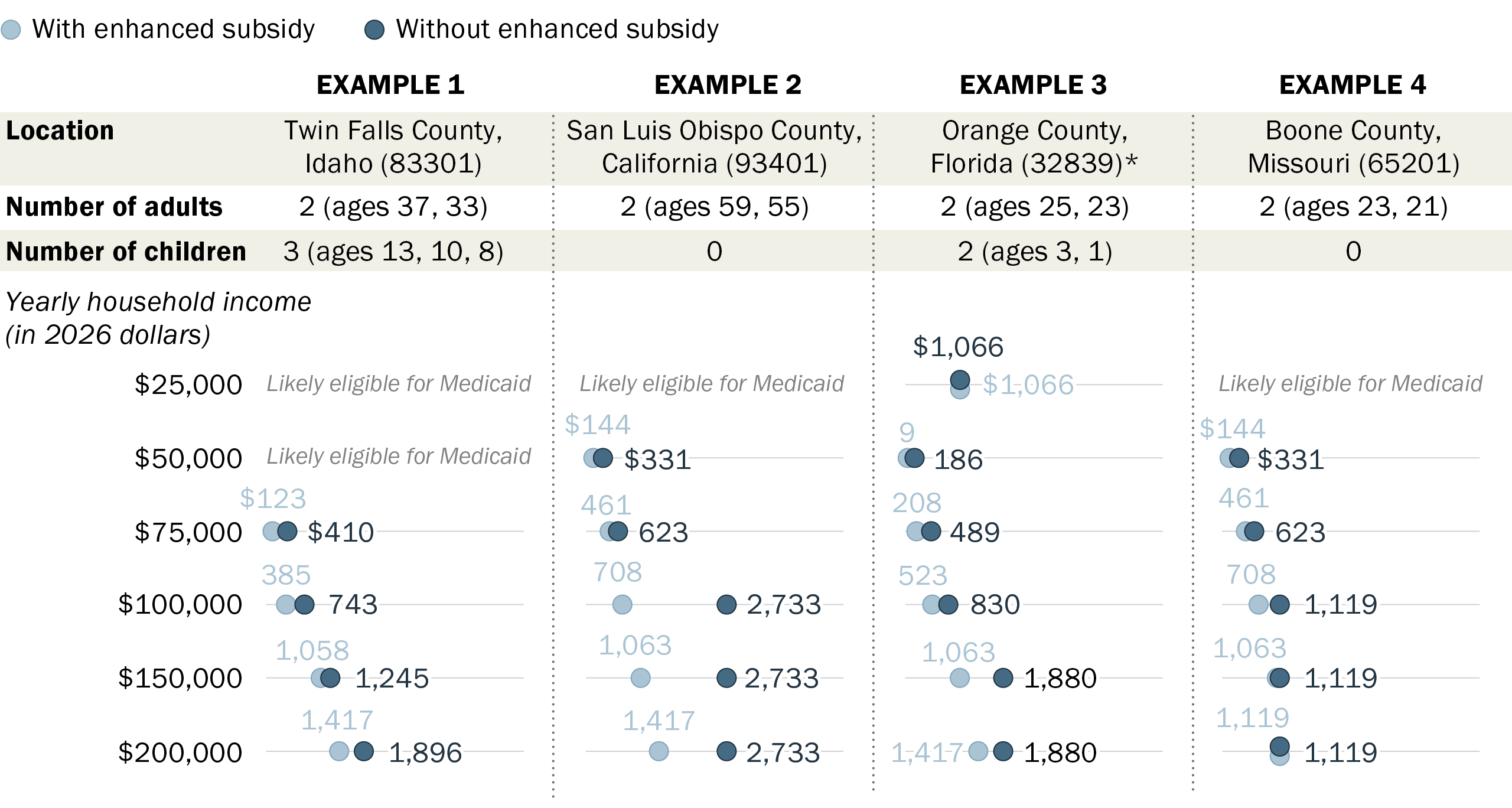
* In this scenario, at the $25,000 household income level, the adults would not be eligible for either Medicaid or financial assistance through the Affordable Care Act. The children likely would be eligible for Medicaid or Children’s Health Insurance Program at the $25,000 and $50,000 household income levels, and so are excluded from those estimates.
Source: Pew Research Center analysis using KFF’s ACA Enhanced Premium Tax Credit Calculator.
Source: Pew Research Center analysis using KFF’s ACA Enhanced Premium Tax Credit Calculator.
PEW RESEARCH CENTER
How much will losing enhanced Affordable Care Act subsidies cost people? It depends on who they are and where they live
Monthly cost for a Silver plan under the Affordable Care Act
| Example Scenarios | Monthly cost with enhanced premium tax credit | Monthly cost without enhanced premium tax credit |
|---|---|---|
| EXAMPLE 1: | ||
| Location: | Twin Falls County, Idaho | |
| # of adults: | 2 (ages 37, 33) | |
| # of children: | 3 (ages 13, 10, 8) | |
| Yearly household income (in 2026 dollars) | With enhanced premium tax credit | Without enhanced premium tax credit |
| $25,000 | Likely eligible for Medicaid | Likely eligible for Medicaid |
| $50,000 | Likely eligible for Medicaid | Likely eligible for Medicaid |
| $75,000 | $123 | $410 |
| $100,000 | $385 | $743 |
| $150,000 | $1,058 | $1,245 |
| $200,000 | $1,417 | $1,896 |
| EXAMPLE 2: | ||
| Location: | San Luis Obispo County, California | |
| # of adults: | 2 (ages 59, 55) | |
| # of children: | 0 | |
| Yearly household income (in 2026 dollars) | With enhanced premium tax credit | Without enhanced premium tax credit |
| $25,000 | Likely eligible for Medicaid | Likely eligible for Medicaid |
| $50,000 | $144 | $331 |
| $75,000 | $461 | $623 |
| $100,000 | $708 | $2,733 |
| $150,000 | $1,063 | $2,733 |
| $200,000 | $1,417 | $2,733 |
| EXAMPLE 3: | ||
| Location: | Orange County, Florida* | |
| # of adults: | 2 (ages 25, 23) | |
| # of children: | 2 (ages 3, 1) | |
| Yearly household income (in 2026 dollars) | With enhanced premium tax credit | Without enhanced premium tax credit |
| $25,000 | $1,066 | $1,066 |
| $50,000 | $9 | $186 |
| $75,000 | $208 | $489 |
| $100,000 | $523 | $830 |
| $150,000 | $1,063 | $1,880 |
| $200,000 | $1,417 | $1,880 |
| EXAMPLE 4: | ||
| Location: | Boone County, Missouri | |
| # of adults: | 2 (ages 23, 21) | |
| # of children: | 0 | |
| Yearly household income (in 2026 dollars) | With enhanced premium tax credit | Without enhanced premium tax credit |
| $25,000 | Likely eligible for Medicaid | Likely eligible for Medicaid |
| $50,000 | $144 | $331 |
| $75,000 | $461 | $623 |
| $100,000 | $708 | $1,119 |
| $150,000 | $1,063 | $1,119 |
| $200,000 | $1,119 | $1,119 |
* In this scenario, at the $25,000 household income level, the adults would not be eligible for either Medicaid or financial assistance through the Affordable Care Act. The children likely would be eligible for Medicaid or Children’s Health Insurance Program at the $25,000 and $50,000 household income levels, and so are excluded from those estimates.
Source: Pew Research Center analysis using KFF’s ACA Enhanced Premium Tax Credit Calculator.
Source: Pew Research Center analysis using KFF’s ACA Enhanced Premium Tax Credit Calculator.
PEW RESEARCH CENTER
