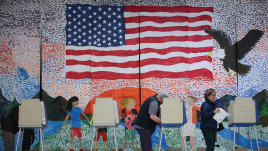
On the Country’s 250th Anniversary, the American People Are in a Sour Mood
Still, many express some optimism: Most people say they feel “hopeful” and 54% say they’re “happy” when thinking about the future.
Numbers, Facts and Trends Shaping Your World
Read our research on:

Still, many express some optimism: Most people say they feel “hopeful” and 54% say they’re “happy” when thinking about the future.

Fresh data delivered Saturday mornings
All
Publications
More than a year after the 2011 uprisings, Arab publics are concerned about the economy, but hopeful about democracy.
More than a year after the first stirrings of the Arab Spring, there continues to be a strong desire for democracy in Arab and other predominantly Muslim nations. A substantial number in key Muslim countries also want a large role for Islam in political life. Meanwhile, few think the U.S. favors democracy in the Middle East.
On the eve of the first presidential election of the post-Mubarak era, Egyptians remain hopeful about the future of their country, and they strongly desire both an improved economy and the democratic freedoms they were denied under the previous regime.
A solid majority of Russians see attending protests as an opportunity to speak out about how the government is run, and more than half specifically approve of the mass demonstrations that followed the December 2011 parliamentary vote, which was marred by fraud allegations. Nonetheless, 72% of Russians voice a favorable opinion of Vladimir Putin.
A year after the ouster of Hosni Mubarak, a new nationwide survey finds that Egyptians remain upbeat about the course of the nation and prospects for progress. Most Egyptians continue to support democracy, and most also want Islam to play a major role in society.
Two decades ago, a survey conducted by the Times Mirror Center of the Soviet Union during perestroika showed a huge divide between hardline communists and the young, urban Russians who backed Boris Yeltsin and favoured a free market economy. Last weekend’s election results show how the divide endures 20 years on. A new Pew Research […]
Overview Two decades after the Soviet Union’s collapse, Russians, Ukrainians, and Lithuanians are unhappy with the direction of their countries and disillusioned with the state of their politics. Enthusiasm for democracy and capitalism has waned considerably over the past 20 years, and most believe the changes that have taken place since 1991 have had a […]
Pro-democracy movements in Tunisia and Egypt recall the wave of democratization that took place two decades ago in Eastern Europe. The experience of Eastern Europe is a useful reminder that public enthusiasm for democracy is not guaranteed as political change extends over years and decades.