Americans want transparency when AI is used in their healthcare
About seven-in-ten U.S. adults (72%) say it’s extremely or very important that a doctor or other healthcare provider tells them if they’re using AI in their healthcare.
Numbers, Facts and Trends Shaping Your World
Read our research on:

All
Publications
About seven-in-ten U.S. adults (72%) say it’s extremely or very important that a doctor or other healthcare provider tells them if they’re using AI in their healthcare.
Americans use chatbots for a host of health-related reasons, from helping make diagnoses on their own to learning more about information they may have gotten from a doctor. Nearly all chatbot health users find this AI information helpful.
In a random sample of 10,000 webpages collected in July 2026, one-in-ten show signs of being written or substantially edited by AI.
About half of Americans say they’re more concerned than excited about AI, and young adults’ concern is rising.
Most Americans see China as more advanced than the U.S. in AI development, while 43% say U.S. leadership in AI is extremely or very important.
More Americans are using chatbots, and some are adopting AI summaries and smart speakers. But views about AI and how fast it’s advancing tilt negative – even for younger adults.
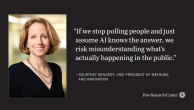
Courtney Kennedy, vice president of methods and innovation, answers some common questions about the current polling landscape in the U.S.
Over 1,500 new data centers are in development nationwide. Most will be built in rural areas, particularly the South and Midwest, marking a shift from urban locations.
Drawing on five years of Pew Research Center surveys, here are 13 findings about how Americans use and view AI, and where they see promise and risk.
More Americans say data centers have a negative effect on the environment, home energy costs and people’s quality of life nearby than say they have a positive effect.