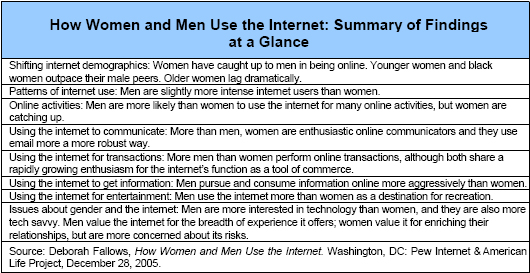
Summary of Findings
Shifting internet demographics: Women have caught up to men online. Younger women and black women outpace their male peers. Older women lag dramatically.
The internet was dominated by men in its early days, but by 2000 and continuing on to today, the user population has been evenly divided between men and women. Further, the proportion of women online is nearly equal to that of men. A review of the findings of the Pew Internet & American Life surveys between March 2000 and September 2005 highlights some particularly interesting trends and correlations: Young women are more likely to be online than young men. And black women have surged online in the last three years.
Pew Internet Project surveys between January and June in 2005 show that 67% of the adult American population goes online, including 68% of men and 66% of women. But women slightly outnumber men in the internet population because they make up a greater share of the overall U.S. population.
- Younger women are more likely than younger men to be online; older men are more likely than older women to be online: 86% of women ages 18-29 are online, compared with 80% of men that age. On the other hand, 34% of men 65 and older use the internet, compared with 21% of women that age.
- Black women are more likely than are black men to be online: 60% of black women are internet users compared with 50% of black men.
- Unmarried men are more likely than unmarried women to be internet users. 62% of unmarried men compared with 56% of unmarried women go online. Married women are slightly more likely than married men to be online. 75% of married women and 72% of married men go online.
- Men without children under age 18 are more likely than women without children under age 18 to be online. Some 61% of childless men compared with 57% of childless women go online. Men and women with minor children are equally likely to be online. Some 81% of men with children and 80% of women with children go online.
Patterns of internet use: Men are slightly more intense internet users than women.
Various measures of intensity of internet use suggest men are slightly more engaged with their internet use than women.1
- On a typical day, wired men are more likely than wired women to go online: 61% of men and 57% of women go online on a typical day.
- Men go online more frequently than women. 44% of men go online at least several times a day, compared with 39% of women.
- Men are more likely than women to have high-speed connections at home. 52% of men and 48% of women have high-speed connections at home.
- Men and women are equally likely to access the internet from home. 89% of men and 87% of women use the internet at home.
- Men and women are equally likely to access the internet from work. Among internet users who work full-time or part-time, 65% of men and 66% of women use the internet at work.
Online activities: Men are more likely than women to use the internet for many online activities, but women are catching up.
Men and women are equally likely to go to the internet for a wide variety of activities, from getting travel information to doing banking to looking up phone numbers and addresses. Men go online in greater numbers than women for a vast, but scattered array of other activities. Women outpace men for a small number of activities, including the areas of health and medicine and religion.
At the same time, women are closing the gap with men. Comparing where internet users were in 2002 to where they are today:
- Compared with women, online men are more likely to use the internet to: check the weather, get news, get do-it-yourself information, check for sports information, get political information, get financial information, do job-related research, download software, listen to music, rate a product/person/service through an online reputation system, download music files, use a webcam, and take a class.
- Compared with men, online women are more likely to use the internet to: send and receive email, get maps and directions, look for health and medical information, use web sites to get support for health or personal problems, and get religious information.
- The growth rate for women’s participation in these online activities is greater than the growth rate for men: using government web sites, getting religious information, watching video clips or listening to audio clips, getting news and maps or directions, researching products
Using the internet to communicate: More than men, women are enthusiastic online communicators and they use email in a more robust way.
More women than men send and receive email, and they use it in a richer and more engaging way. Women are more likely than men to use email to write to friends and family about a variety of topics, from sharing news and worries to planning events to forward jokes and funny stories. Men and women both appreciate email for its efficiencies and convenience, but women are more likely to feel satisfied with the role of email in their lives, especially when it comes to nurturing their relationships.
In emailers’ working life, women are more likely than men to value the positive effects of email for improving relationships, from expanding their circle of colleagues to encouraging teamwork. Women also value email for a kind of positive, water-cooler effect, which lightens the atmosphere of office life.
Men are more likely than women to participate in a big variety of interest groups, like fan clubs or community groups. Men and women both engage with such groups for the hard facts and news they learn online. Women place a higher value than men on what email does for the relationships within the group.
- Women send and receive email more than men. Some 94% of online women and 88% of online men use email.
- Women do more in personal emails with friends and family. More women than men write emails about news, worries, advice and planning.
- Women are more likely than men to value their email with friends, family, and work colleagues. Women say email improves relationship with friends, family, and colleagues more than men do, and that it improves the work climate as well.
- Men communicate online with more kinds of special interest groups.
Using the internet for transactions: More men than women perform online transactions, although both share a rapidly growing enthusiasm for the internet’s function as a tool of commerce.
Men and women use the internet similarly for the many of the most standard kinds of transactions, from purchasing products to doing travel arrangements to banking. More men than women use the internet for some less predictable and even more risky transactions, such as doing auctions or trading stocks.
Transactions represent some of the fastest-growing online activities among men and women alike, with participation in banking more than doubling over the last five years, and doing travel arrangements, auctions, and purchasing not far behind.
Both men and women value the internet for its famous speed and efficiency in making transactions easier.
Using the internet to get information: Men pursue and consume information online more aggressively than women.
Men look for information on a wider variety of topics and issues online than women do, from researching products to buy to getting information on their hobbies to looking for political news. Sometimes, men and women look for different kinds of information. After the events of September 11, men visited more websites to tell them about things that were happening; more women said the internet helped them find people they needed to reach.
As vehicles for finding information, search engines are extremely popular among both men and women. About 90% of men and women who go online use search engines, and about 40% use them on a typical day. Men and women generally use the same kinds of search strategies, using search engines most commonly, but also starting searches on familiar, proprietary websites or following recommended links.
Although men and women say equally that they find the information online that they are looking for, men are a lot more confident in themselves as searchers, and they are less overwhelmed by the glut of information that’s out there.
- Men and women both use search engines heavily. 90% of online men and 91% of online women use search engines; 43% of those men and 39% of those women use them on an average day.
- Men and women are equally satisfied users of search engines, but men are more confident than women as searchers. Among searchers, 88% of men and 86% of women say they find the information they are looking for; 54% of men and 40% of women have self-confidence as searchers.
- Women feel the glut of online information more than men do. Although both men and women like having a lot of information available in their world, 24% of women feel its overload compared with 19% of men.
Using the internet for entertainment: Men use the internet more than women as a destination for recreation.
Men use the web for more kinds of entertainment and recreation than women do, with just a few exceptions. Women play games as much as men, they listen to audio clips and watch video clips, and they share files. But men pursue a host of other activities with greater enthusiasm.
- Men are more likely than women to engage in lighthearted activities online, such as pursuing their hobbies, participating in sports fantasy leagues, downloading music and videos, and remixing files, as well as more serious activities, such as reading for pleasure and taking informal classes.
Issues about gender and the internet: Men are more interested in technology than women, and they are also more tech savvy. Men value the internet for the breadth of experience it offers; women value it for enriching their relationships, but they’re more concerned about its risks.
The Pew Internet Project surveys show that compared with women, men are more interested in the world of technology and how their own gadgets and systems work. Men try more new things, from hardware to software. As a natural consequence, men are more adept at dealing in the tech world, from installing filters to troubleshooting repairs. And they are more confident in their roles as techies and geeks.
Men and women share an appreciation of what the internet does for their lives, particularly in making their lives more efficient and expanding their world of information. Men seem to value these strengths most in the context of the activities of their lives, from jobs to pastimes, while women seem to value them most in the context of the relationships with family, friends, colleagues, and communities.
Men and women share concerns about personal risks and dangers from being online, from privacy concerns to credit card theft to contracting computer viruses. But women have expressed more fears than men have about the internet being a vehicle for national and worldwide problems. These include general criminal use of the internet, child pornography, organized terrorism, and hacking into government information. For online chats and discussion groups, women’s dramatic decline in participation rates coincided with increased public awareness about worrisome behavior in chat rooms.
- Men are significantly more likely than women to know the latest terms, from “RSS feed” to “phishing,” and to have heard about the latest tech-related issues.
- Significantly more men than women maintain and fix their own computers.
- Men are more likely than women to try new gadgets and applications and software.
- Significantly more men are more confident in themselves as searchers and geeks.
- Women are more concerned than men about general criminal use of the internet.