[1]
In the general election battle, Obama’s campaign has remained deeply active in the social networking world and has maintained dominance over McCain. Coming out of the Republican Convention, McCain has stepped up his presence in the social networking world, but there is still a long gap.
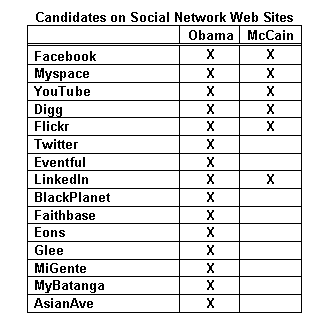
McCain’s Web site does not link to any social networking sites on its home page but maintains a presence on six: MySpace, Facebook, YouTube, Digg, Flickr and—added in September—LinkedIn. But is it up to supporters to find these pages on their own. The McCain Web site also recently added a tool that allows members of 27 different social networking sites to quickly forward Web content—text, photos, and video—to fellow social networkers.
In addition, unofficial, user-created groups that support for McCain exist on three other networking sites: BlackPlanet, targeted at the African American community, Faithbase, a Christian social networking site and Eons, which calls itself the online community for (baby) boomers.
MySpace and Facebook
A close look at listed MySpace “friends” and Facebook supporters on the popular social networking sites reveals the tremendous advantage established by Obama, despite recent steps by the McCain campaign at gaining ground.
As of early September, Obama has more than a 5-to-1 lead over McCain in number of friends. This is down from a 7-to-1 advantage a month earlier.
A larger social networking base gives the Obama campaign a more sizeable built-in audience of supporters for direct updates and appeals.

[2]
YouTube
Similar to the lopsided social networking campaign, McCain’s official YouTube channel as of August had fewer than a quarter as many videos as Obama’s. The Obama channel also had about five times as many subscribers, and most telling, more users have visited Obama’s YouTube channel page, by a staggering 11-to-1 margin.
Through a series of video ads painting Obama as an inexperienced “celebrity,” McCain gained some ground on Obama in recent weeks, though it made little real dent in the Obama lead.
[3]

But by all indications, Obama continues to be more prominent on YouTube. In absolute terms—number of channel visitors, new subscribers, videos watched and new videos posted—he continues to far outpace McCain.
FOOTNOTE:
1. Chris Hughes, an original Facebook founder, joined the Obama campaign in early 2007 and engineered its media strategy, building online social networking tactics beyond personal computers and the Web to mobile devices and the offline world. Brian Stelter, “The Facebooker Who Friended Obama,” New York Times, July 7, 2008.
2. Ibid.
3. Stephen Dinan, “McCain Takes Lead on YouTube Hits,” The Washington Times, August 8, 2008.