Parental worries vary considerably across income groups in the United States. From struggles with mental health to concerns about physical safety and teen pregnancy, parents with relatively low household incomes are the most likely – and those with upper incomes are the least likely – to express a high level of concern.
Despite their concerns, lower-income parents are more likely than those with middle and upper incomes to say parenting is enjoyable and rewarding all of the time. But lower-income parents are also more likely than those with upper incomes to say parenting is stressful all or most of the time.
Nearly nine-in-ten parents in each income group say parenting is one of the most important aspects to who they are as a person, but larger shares of lower-income parents than those with middle and upper incomes say it’s the most important aspect. Lower-income parents are also the least likely to say they are trying to raise their children similarly to how they were raised; upper-income parents are the most likely to say this.
Four-in-ten lower-income parents are extremely or very worried about their child getting shot
By margins ranging from 10 to 34 percentage points, larger shares of lower-income parents than those with middle and upper incomes say they are extremely or very worried about each of the following happening to their children at some point: struggling with anxiety or depression, being bullied, being kidnapped or abducted, getting beaten up or attacked, having problems with drugs or alcohol, getting shot, getting pregnant or getting someone pregnant as a teenager, and getting in trouble with the police. (Only parents with children under age 18 were included in this study.)
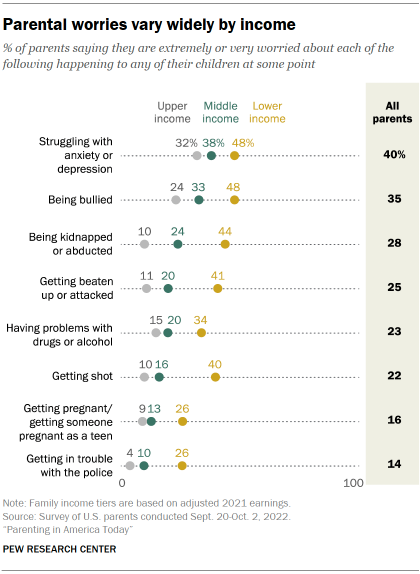
Among parents with middle and upper incomes, mental health concerns top the list of parental worries, followed by concerns about bullying. About four-in-ten middle-income parents (38%) and 32% of those with upper incomes say they are extremely or very worried that their children might struggle with anxiety or depression at some point. A third of middle-income parents and about a quarter (24%) of those with upper incomes are similarly concerned about their children being bullied, while considerably smaller shares say they are extremely or very concerned about the other items on this list.
Among lower-income parents, mental health and bullying are also top concerns, with roughly half saying they are extremely or very concerned about their children struggling with anxiety or depression or being bullied (48% each). But other concerns are also top of mind for lower-income parents: 44% are extremely or very concerned about their children being kidnapped or abducted, and similar shares are equally concerned about them getting beaten up or attacked (41%) or getting shot (40%). In fact, lower-income parents are four times as likely as upper-income parents to express concerns about their children being the victim of a shooting (10% of upper-income parents say they are extremely or very worried about their children getting shot).
While parents in different income groups have different concerns, they largely share similar goals and aspirations for their children, with large majorities of lower-, middle- and upper-income parents saying it’s extremely or very important to them that their children be honest, ethical and hardworking as adults and that they be financially independent and have jobs or careers they enjoy. And relatively small shares – about one-in-five in each group – place a lot of importance on their children getting married and having children of their own in the future.
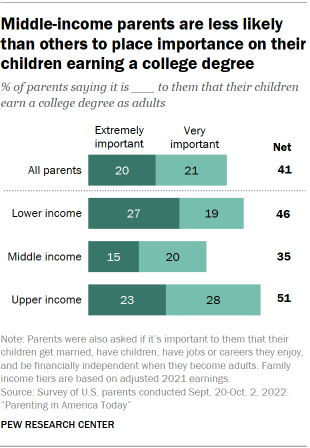
There are some differences, however, when it comes to the emphasis parents put on attaining a college degree: 46% of lower-income parents and 51% of upper-income parents say it is very or extremely important to them that their children earn a college degree, compared with 35% of middle-income parents. Looking at parents’ own educational attainment, 51% of those with a postgraduate degree say it’s extremely or very important to them that their children graduate from college, followed by 43% of those with a bachelor’s degree and 40% of those with a high school diploma or less education. Parents with some college experience are the least likely to say it’s extremely or very important to them that their children earn a college degree (33% say this).
Lower-income parents are the least likely to say they are trying to raise their children the way they were raised
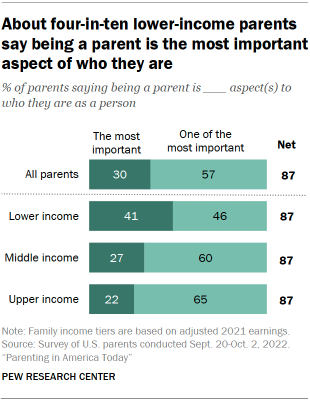
Across income groups, nearly nine-in-ten parents say being a parent is the most important or one of the most important aspects to who they are as a person (87% in each group say this), but those with lower incomes (41%) are much more likely than those with middle (27%) and upper incomes (22%) to say it is the most important aspect.
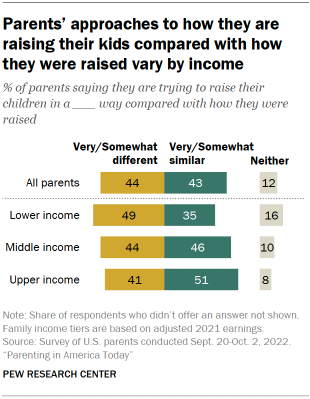
When asked if they are trying to raise their children similarly to or differently from how they were raised, about half of parents with lower incomes (49%) say they are trying to raise their children in a different way, while a smaller share (35%) say they are raising their children similarly to how they were raised. In contrast, those with upper incomes are more likely to say they are raising their children in a similar way to how they were raised (51%) than to say they’re raising them differently (41%). Middle income parents are more evenly divided: 46% say they are raising their kids in a similar way to how they were raised, and 44% say they are raising them differently.
Related: How Today’s Parents Say Their Approach to Parenting Does – or Doesn’t –Match Their Own Upbringing
There are also some differences by income when it comes to parenting styles. While more parents across income groups say they tend to be overprotective rather than give their children too much freedom, those with lower (50%) and middle (45%) incomes are more likely than those with upper incomes (40%) to describe themselves as overprotective.
In turn, upper-income parents are more likely than those with middle and lower incomes to say they tend to push their children too hard rather than not hard enough and to offer too much criticism rather than too much praise, although majorities or pluralities across income groups say none of these describes their parenting style. About a third of upper-income parents (32%) say they push their children too hard, compared with 26% of middle-income and 20% of lower-income parents. And while 28% of parents with upper incomes say they tend to criticize their children too much, 22% of those with middle incomes and just 12% of lower-income parents say the same.
Lower-income parents are more likely than those with higher incomes to say parenting is rewarding, enjoyable all of the time
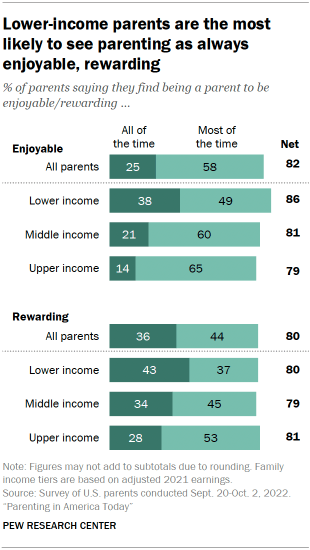
Across income groups, majorities of about eight-in-ten or more say they find being a parent to be rewarding and enjoyable all or most of the time, but lower-income parents are the most likely to say this is always the case. Some 43% of lower-income parents say being a parent is rewarding all of the time, compared with 34% of middle-income parents and 28% of those with upper incomes. And while 38% of parents with lower incomes say being a parent is always enjoyable, 21% of those with middle incomes and just 14% of parents with upper incomes say the same.
Lower-income parents – and those with middle incomes – are also more likely than upper-income parents to say parenting is stressful all or most of the time (33% and 29% vs. 22%, respectively). While relatively small shares of parents across income groups say parenting is stressful all of the time, those with lower incomes (11%) are more likely than those with middle and upper incomes (6% each) to say this.